
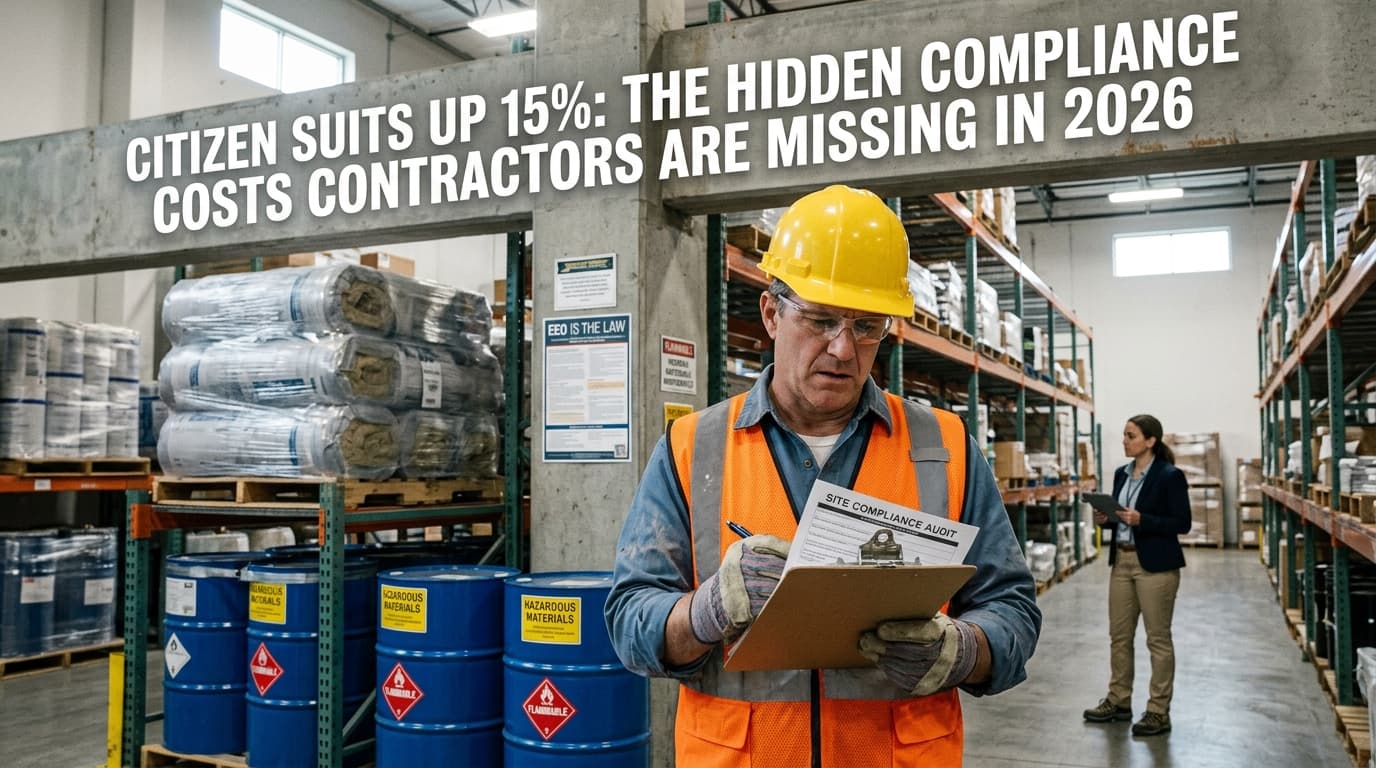
Citizen Suits Are Up 15% and Federal Contractors Are in the Crosshairs
Environmental violations that once flew under federal radar are now being caught and prosecuted by private citizens at an unprecedented rate. Citizen suit filings for environmental violations increased 15% in 2025, signaling a fundamental shift in how government contract environmental compliance gets enforced. While federal agencies face workforce reductions and reorganizations that are contributing to morphing agency priorities, private enforcement is filling the oversight gap with lawsuits that can devastate unprepared contractors.
This surge in private enforcement creates a dangerous blind spot for contractors who assume reduced federal oversight means relaxed compliance requirements. The reality is starkly different. Environmental contractors bidding on government work now face scrutiny from multiple angles: traditional federal oversight, aggressive private enforcement, and stricter participation requirements that demand licensed and certified expertise at every project phase.
The stakes have never been higher. Delayed reporting or incomplete environmental submissions trigger enforcement actions, fines, or litigation that can shut down projects and terminate contracts. For contractors pursuing federal work in 2026, understanding this new enforcement landscape isn't optional; it's survival.
The Compliance Paradox: Deregulation Doesn't Mean Less Scrutiny
Federal procurement is shifting toward faster buying and reduced regulatory burdens, moving away from decades of regulatory accumulation. The Department of Government Efficiency (DOGE) contract terminations are creating uncertainty in the federal contracting landscape, and federal policy momentum is accelerating toward commercial-first acquisition approaches in 2026. Yet environmental compliance is becoming more complex, not simpler.
New stormwater management rules and hazardous-material handling requirements in 2026 are layering additional complexity onto existing frameworks. PFAS management remains a long-term environmental and regulatory challenge extending beyond 2026, requiring contractors to implement detection, containment, and remediation protocols that didn't exist five years ago. Supply-chain resilience has become a sustained pressure point for federal contractors navigating 2026 budgets, demanding documentation and verification at every level.
This creates a paradox that catches many contractors off guard. You might expect procurement streamlining to reduce compliance burdens, but environmental requirements are intensifying regardless of broader deregulation trends. The contractors who thrive understand that government contract environmental compliance demands both speed and precision: qualities that only come from established systems and licensed expertise.
MBE and WBE Participation: 2% and 3% Aren't Just Numbers
Title 40 CFR Part 33 sets clear participation goals that many contractors treat as suggestions rather than requirements. MBE participation must reach 2% of total project dollar value, while WBE participation must hit 3% of total project dollar value. These aren't aspirational targets; they're mandatory thresholds that can determine contract awards and ongoing compliance.
Documentation matters more than good intentions. You need verifiable proof that your minority and women-owned business enterprise subcontractors meet certification requirements, maintain current licenses, and can deliver their contracted scope of work. This verification process extends beyond initial bid submissions to ongoing project management and final reporting.
The consequences of getting this wrong are severe. Lapsed or incorrect licensing in construction projects can stop work entirely and put insurance coverage at risk. When your MBE or WBE subcontractor loses certification mid-project, you're not just facing participation shortfalls. You're looking at potential contract termination and legal exposure. Green and sustainability mandates at local levels require contractors to understand jurisdiction-specific environmental requirements, adding another layer of complexity to subcontractor vetting and management.
Licensing Verification: The Non-Negotiable Gate
Every license, permit, and professional credential must be current for every jurisdiction where your projects are active. This isn't a one-time check during bid submission; it's an ongoing verification requirement that extends throughout project duration and into warranty periods. Contractors must verify all licenses, permits, and professional credentials are current for every jurisdiction where projects are active, and the consequences of lapses are immediate and severe.
Work stoppages, insurance gaps, and contract termination can result from a single expired license or lapsed certification. The verification burden extends to every subcontractor, supplier, and professional service provider on your team. You're responsible for their compliance status, and their failures become your liability.
Heightened cybersecurity requirements are a defining theme for government contractors in 2026, adding another verification layer to the licensing landscape. Your team needs current cybersecurity certifications, data handling protocols, and secure communication systems that meet federal standards. Licensed and certified contractors provide the risk mitigation that federal agencies demand in this high-stakes environment.
Supply Chain Resilience and PFAS: Long-Term Compliance Pressures
Supply-chain resilience requirements are reshaping how contractors source materials, vet suppliers, and document compliance throughout project lifecycles. You can't simply rely on supplier certifications. You need independent verification that materials, equipment, and services meet federal environmental standards. This verification process extends to PFAS management protocols that affect everything from foam insulation to protective equipment.
PFAS management protocols now require contractors to test, document, and remediate per-and polyfluoroalkyl substances across multiple project phases. These requirements affect material sourcing decisions, worker safety protocols, and long-term environmental monitoring that extends well beyond project completion. EPA and OSHA compliant frameworks are evolving to address PFAS challenges, creating new documentation and reporting requirements.
The contractors who succeed understand that these aren't temporary compliance hurdles; they're permanent features of the federal contracting landscape. Forward-planning becomes essential when compliance requirements can shift mid-project and affect materials that were specified months earlier.
Your Compliance Roadmap: What Licensed Contractors Must Do Now
Your immediate priority is auditing current licenses and credentials across all jurisdictions where you operate. This audit must include every subcontractor, supplier, and professional service provider on your approved vendor list. Expired licenses, lapsed certifications, and incomplete documentation create immediate project risks that can trigger work stoppages and contract termination.
Verify subcontractor participation documentation for MBE and WBE compliance before your next bid submission. This verification process should include current certification status, licensing verification, and capability assessments that confirm each subcontractor can deliver their contracted scope. Don't wait until contract award to discover participation gaps or licensing issues.
Implement cybersecurity protocols that meet federal data handling requirements. This includes secure communication systems, data encryption protocols, and access controls that protect sensitive project information. Establish PFAS and stormwater management procedures aligned with 2026 rules, including testing protocols, remediation procedures, and long-term monitoring requirements.
Central Insulation Systems' AI-powered compliance workflows and eezyRank automation provide the systematic approach that government contract environmental compliance demands. Our licensed and certified team has delivered EPA and OSHA compliant solutions for 35+ years, understanding that compliance creates competitive advantage rather than operational burden. Call (513) 242-0600 for free estimates and professional consultation on your federal contracting compliance requirements. Start implementing these compliance measures today to protect your contracts and position your business for sustainable growth in the evolving federal marketplace.


